
Resource & Recovery Center
What is the purpose of the Resource & Recovery Center?
The Resource & Recovery Center provides services that were previously delivered at the Downtown Engagement Center (DEC). The DEC provided a variety of resources to meet the immediate needs of individuals who are unhoused and at risk of becoming unhoused. Resources such as food, medical care, restrooms and showers, laundry, as well as housing navigation services, behavioral health support, and brain injury support groups were previously provided at the DEC and are now available at the new location. With varying levels of frequency, more than 20 partners continue to provide 40+ services to the guests we serve.
The new space at the Resource & Recovery Center continues to foster pathways to housing, treatment and achieving clients’ personal goals while also filling critical gaps and expanding services, such as mental health, health care and housing navigation. The new space provides room for more on-site partners, collaboration and programming, and its design will allow staff to work more efficiently.
By bringing state, city and nonprofit organizations together under one roof, the initiative will strengthen collaboration and improve outcomes. Locating services on one floor, paired with improved management of outside activity, enhances accessibility and safety. Finally, the space addresses a long-standing infrastructure gap by providing emergency flex space that supports the broader community.
How will it work?
The new facility:
- Provides adequate space for on-site partners, expands access to health care, housing navigation, and behavioral health resources.
- Supports coordinated efforts between a multitude of partner organizations, leading to more sustainable outcomes for those served.
- Enhances safety and visibility through a single-level layout designed for effective management of outdoor and indoor activity.
Services available include, but are not limited to:
- Housing problem-solving, housing search, and stabilization support to help individuals identify pathways out of homelessness and secure stable housing.
- Critical medical care and connections to ongoing primary healthcare services, including chronic disease management and preventative care.
- Resource navigation, benefits access, and application assistance, including support with health insurance enrollment, SNAP, WIC, and other essential public benefit programs.
- Services that address mental health and substance use challenges are often provided by the Southeast Behavioral Health Clinic. Peer support and care coordination are provided by a multitude of agencies.
- Mental health, substance use, peer support, and care coordination services that connect individuals to treatment, recovery support, and ongoing assistance.
- Culturally responsive programming, community connection, and supportive services designed to reflect the diverse traditions, values, and lived experiences of those served.
- Specialized services for veterans, youth, individuals living with brain injuries, and others with unique or complex support needs.
Community Partner Presence
Community partners providing services at the Resource & Recovery Center include co-located providers such as Family Health Care Center’s Homeless Health Services Clinic and Presentation Partners in Housing’s Housing Navigation Program.
Organizations that provide outreach and specialized support include:
- Southeast Behavioral Health Clinic
- Deep Roots
- Sweet Medicine
- Arkos Health
- Community Options
- Better Together
- Youthworks
- Fraser Ltd./Stepping Stones
- Native, Inc.
- Healing Circle
- VA Homeless Outreach
- Southeastern North Dakota Community Action Agency (SENDCAA)
- Solerra (formerly Rape & Abuse Crisis Center)
- Great Plains Food Bank
- Legal Services of North Dakota
Why did services of the DEC have to move?
The DEC’s previous building was originally intended as a temporary location. Due to the layout of the building, DEC services spanned three levels, creating challenges from a staffing and visibility standpoint. The items below outline those challenges:
- Inefficient facility
- Problematic location for local businesses
- A fragmented 3-level layout results in significant staffing challenges
- Insufficient interior space limits partner services
- Insufficient outdoor space creates spillover onto streets
- Lack of windows for visibility to outside limited the management of street activity
How was the new location chosen?
Through a unique and no-cost partnership with consultants from Bloomberg Associates, the City identified three sites for potential relocation of the DEC. In no specific order, those sites were:
• 610 North University Drive, Fargo
• 720 14th Street North, Fargo
• 2001 1st Avenue North, Fargo
On Monday, September 15, 2025, Brenda Derrig, Assistant City Administrator, provided an update during the Fargo City Commission meeting.
A Town Hall Meeting and Community Input Opportunity regarding relocation of the Downtown Engagement Center was held on Tuesday, September 23, 2025, at Fargo City Hall. Community members and local elected officials in attendance heard from a panel of City staff and partners who provide services at the DEC. Attendees then had an opportunity to ask questions and share their input on this important topic. Community members who were not able to attend the Town Hall meeting were invited to share their input through an online survey. There were more than 500 responses to the survey, which opened on Wednesday, September 16 and closed on Thursday, September 25.
At its September 29, 2025, meeting, the Fargo City Commission received updates on both the Town Hall Meeting and the three previously identified potential relocation sites for the DEC. After that meeting, City staff continued working with Bloomberg Associates to assess the three potential relocation sites, with specific attention given to the functionality of each space as well as cost information.
At its Monday, October 27 meeting, the Fargo City Commission approved relocation of the DEC to 2001 1st Avenue North, along with a lease agreement with Bullinger Enterprises, LLLP, and a fiscal sponsorship agreement and administrative fee agreement with Fargo-Moorhead Area Foundation.
Relocation Fit-up
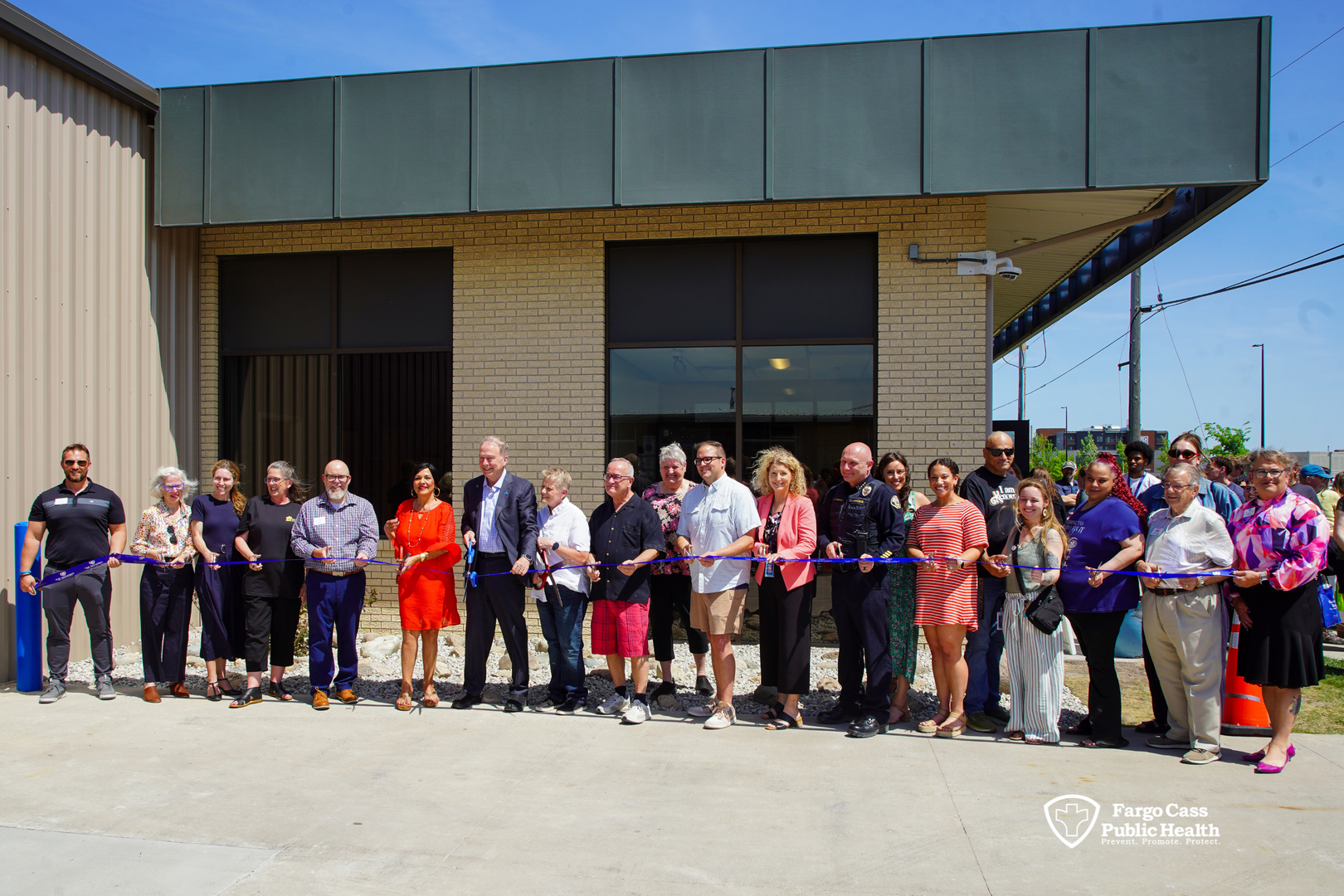
Construction and fit-up of the new Resource & Recovery Center began on Monday, February 2, 2026. With construction and fit-up complete, the Resource and Recovery Center officially opened and began providing services on Monday, June 15.
Community Support
Through a fiscal sponsor agreement with the FM Area Foundation, the City of Fargo has secured financial support from donors to support both fit-up and relocation costs. The approximate fit-up cost of the facility is $1.4 million, of which roughly $750,000 has already been raised. The City will continue to explore a variety of cost-saving options as this project progresses.
The City has not contributed funds to support fit-up and/or relocation costs. Those funds are being drawn from the FM Area Foundation Fund.