
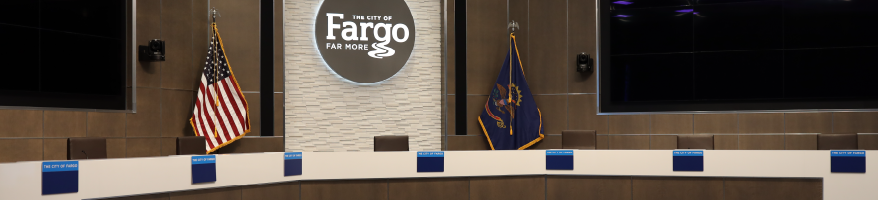
Fargo City Commission Special Meeting - May 14, 2025
The Commissioners present or absent were as shown following:
Present: Kolpack, Piepkorn, Strand, Turnberg, Mahoney.
Mayor Mahoney presiding.
Mayor Mahoney said a lot of hard work by the Fire and Police Departments, Finance and Human Resources went in to developing the Public Safety Sales Tax implementation plan. He said significant effort was involved in reaching this stage, noting the back-and-forth nature of the planning process. He said he was confident the Fire and Police Chiefs' current positions and the proposed plan would be well-received by the departments and the City Commission.
City Administrator Michael Redlinger said the purpose of this meeting was a presentation of the plan, and no voting would occur at this meeting, with a vote scheduled for the next City Commission meeting. He provided a timeline of the project, noting initial work in January and more intensive discussions from March to present. He highlighted the extensive collaboration in developing the implementation plan to honor the voters' wishes and he emphasized the balanced and unified approach of the thoughtfully developed plan. He gave an overview of the Fire Department, noting the last pay structure adjustment was in 2018 and while cost of living and micro-adjustments had occurred, the pay structure had not kept pace with regional market conditions. He said this lag had limited the Fire Department's ability to simultaneously invest in new positions, pay plans and facilities. The Police Department has had exponential growth over the last decade, he stated, outpacing the City's ability to invest in staffing needs. There is a similar situation at the Fire Department, he said, where existing revenues were insufficient for staffing, technology and facility improvements. He said the November 4, 2024 public vote result supported the Public Safety Sales Tax and he presented a timeline of post-election steps from November to May, emphasizing internal conversations and close collaboration with the Fire and Police Departments and he assured the Commissioners that public safety input was fully incorporated into the proposed plan.
Finance Director Susan Thompson said sales tax proceeds will begin to be available for transfer into the City's General Fund by mid-June and the City Commission would be asked annually to consider the utilization of these funds. She said a balanced and sustainable approach over the 20-year period is needed, particularly the first 10 years. She said she has framed the plan as the start of a 10-year vision, with aggressive implementation in 2025-2026 and a comprehensive check-in after the first decade. She presented the public safety priorities, including market-competitive pay structures, staffing, equipment and facilities and said there has been a significant time investment and dialogue with public safety leaders.
Human Resources Director Jill Minette said the proposed implementation date is July 7, 2025, and she provided an overview of the sworn public safety workforce, which includes 192 Police positions and 138 Fire positions, which is about 30% of the City's regular workforce. She outlined the objectives for reviewing public safety compensation and benefits, including: conducting a regional market survey for market competitiveness; considering and minimizing pay compression and overlap; and adding positions in both Fire and Police as a key priority for retention and work-life balance. She said the Human Resource team's regular regional compensation and benefits surveys currently involves more than 30 cities. She stated the plan is to identify a core group of approximately 15 comparable cities for future surveys as part of developing a compensation philosophy and indicated the compensation philosophy and the list of comparable cities would be presented to the City Commission during the budget process. She said the City-wide pay plan proposal from the previous budget process was not fully implemented due to cost; however, a 4.5% COLA was implemented for 2025. The focus of this presentation is on market-competitive public safety pay, she stated, developed collaboratively with Administration, Human Resources, Finance, Police, Fire and MRA. Weekly meetings to analyze market data and develop a sustainable new pay structure were held, she stated and MRA has a 25-year partnership with the City as a compensation consultant.
Christy Reitz, Compensation Director for MRA, presented the regional public safety compensation and benefits survey results and the proposed pay structure. She outlined base pay from the compensation and benefits survey and she explained the process of determining the regional market, focusing on similar-sized municipalities with similar offerings and said 37 municipalities were surveyed across the region, with 23 responses received. She presented current entry and top steps compared to regional market averages by rank. She said each sworn rank has its own separate pay plan compared to the regional market average and she showed the pay structure with no overlap and the comparison of rates to market rates. She highlighted the better alignment of proposed entry and top steps with market comparisons and the narrower range spread and showed how the proposed structure for Police Officers corrects the lagging market alignment. She also demonstrated the correction for market comparisons and the elimination of pay overlap for Police Lieutenants.
Ms. Minette said the proposed pay structure was the result of collaboration among departments and MRA, and emphasized the primary goal of developing a market-competitive and sustainable Public Safety Plan. She said all sworn employees would receive a market adjustment with the amount depending on current pay plan placement and years of service. Some employees would receive lower increases if they are newer or already close to market, she stated, while larger increases were needed for alignment and internal equity.
Ms. Thompson emphasized that the key to the plan is a balanced approach and she stated a balanced plan was achieved by addressing the Chiefs' priorities while respecting available resources. She highlighted the need for realistic and conservative assumptions in the financial model and estimated resources from the new sales tax will be about $8.5 million in 2025, which is about 75% of the collection expected in 2025 due to the April 1st implementation. She presented a graph showing the annual revenue curve assuming 2% growth per year, projecting $11,650,000.00 at the midpoint of year ten. She said she justified the 2% growth assumption based on post-COVID sales tax growth and the commitment is to do an annual review of the financial plan during budget preparation, considering deviations from assumptions to update priorities. She stated that while the tax is for 20 years, the financial model focused on the first 10 years, with a deeper dive into the first three years. She noted the model's sensitivity to revenue and expense changes and listed potential future changes, such as sales tax growth, state legislative initiatives, City population growth, City footprint expansion, public safety needs/service demands and technology innovations. She reaffirmed the commitment to evaluating the model and prioritizing public safety needs relative to available resources during the annual budget process. She said the goal is to develop a plan that balances current public safety priorities with long-term sustainability given revenue assumptions. Approval of the 2026 Public Safety Sales Tax plan would be requested in advance of the full 2026 budget, she said, in order to inform the budget’s development. She said some key points about the financial plan include: $8.5 million is significant; however, it does not cover all requested items; it is too early to plan for General Fund incorporation after the 20-year sunset due to unknowns; the model ensures spending does not exceed anticipated revenues over 10 years; and ongoing discussions are needed for the second decade and beyond year 21. She presented the 2025 and 2026 financial model overview table, showing anticipated revenues, spending totals by category/department and net over/under. She emphasized that the model carries the ongoing incremental costs of pay, staff, equipment and facilities, which the General Fund cannot absorb. The 10-year model extension with the same departmental groupings, she said, highlights the bottom line showing underspending in early years and exceeding revenue later, and nearly breaking even over 10 years. She clarified that this is a snapshot in time to ensure the sustainability of 2025-2026 decisions, with annual adjustments for other factors. She said public safety costs comprise nearly $60 million or about 42% of the City's General Fund and this contribution will continue to rise. She said the primary usage of the tax, which counts for about 80%, includes ongoing costs of new/updated items such as the pay structure, new personnel, facility updates and technology, and the secondary usage, or 20 percent, is for existing public safety debt service and annual capital needs, primarily vehicles.
Fire Chief Steve Dirksen outlined the Fire Department's immediate goals for 2025-2026, with a strong emphasis on employee retention and recruitment. He said fixing existing pay plan issues is the top priority due to a significant decrease in staff. The plan aims to address this by increasing staffing, particularly in the Downtown area, he stated. For 2025, he proposes adding six new personnel to operate a quick response unit, he said, and while hiring will take the rest of this year, these individuals could be deployed by early 2026, boosting the busiest station's capacity to handle Downtown calls and ensuring unit reliability. He said another critical need is addressing the aging station alerting system. Recent issues at Fire Station No. 8 and two other stations highlight the obsolescence of the current system, he said, and a comprehensive replacement across all eight stations is a prudent course of action, he stated. A Fire Facility Study is also crucial, he said, and of the ten facilities, some do not meet current requirements, including one that lacks a sprinkler system and the aging burn building and training facility from the 1960s has structural issues, making it unsafe. Fire Station No. 4, also nearly 60 years old, might be more cost-effective to replace than repair, he said, and the study will provide analysis, cost estimates and location considerations for these replacements. A significant portion of the 2025 budget is allocated for these future facility needs, he stated, ensuring a sustainable long-term approach for 2026 and beyond. Looking specifically at 2026, he said, the plan includes adding another Firefighter position and a Fire Data Analyst, which will improve transparency and inform decisions on response models, and future station placement, ultimately enhancing response times and identifying service gaps. Additionally, he said, a current Firefighter will be promoted to a Fire Training position, and funds will continue to be earmarked for future facility needs. The plan will be continuously monitored and adjusted, he said, and this initial phase covers the next year and a half, prompting future considerations such as the timing, construction and staffing of potential Fire Stations Nos. 9 and 10 as the City grows. Over the next 18 months, these changes will increase sworn positions by seven and add one non-sworn position, bringing the Fire Department's total personnel to 149.
Police Chief David Zibolski said the Police Department's priorities focus on competitive pay, personnel and facilities. The collaborative effort, he stated, has resulted in a sound compensation plan that addresses critical issues. Due to the January and February academy schedule, he said, new sworn officers will not be onboarded until 2026; however, a civilian Police Operations Technician can be added immediately. This role is crucial for managing the increasing IT demands of investigations, particularly video and phone downloads, which are vital evidence, he said. The current single operations technician is at full capacity, he said, and this addition will significantly help with growing workloads and timely expectations in investigations and court cases. Technology upgrades are also planned for body cameras, he said, which will use AI for report narratives, saving officers time while ensuring detailed reports. The Peregrine system will integrate numerous databases into a single dashboard, he said, providing quick and easy access to comprehensive information for all department personnel. The plan also includes $25,000.00 for fitting up headquarters to create suitable workspaces for the Realtime Crime Center and the Crimes Against Children Unit, which currently operate in an open environment, he said, and a small amount is allocated for the motorcycle unit. He said $372,000.00 is for mobile Police vehicle barriers, which is an important public safety investment that has been expedited for deployment this summer. In 2026, he said, the Department aims to add staff at all levels to maintain adequate supervision, middle management and command. The first priority is adding three Lieutenants, he stated, which will provide 24/7 shift command and will allow Sergeants to focus on supervising officers on the street. One new Police Sergeant will be added to lead the Wellness Unit, he said, which is invaluable for recruitment, retention and supporting the 10 to 15 personnel on leave or injury weekly. Five new Police Officers are proposed for the Neighborhood Services Division, he stated, which will be the first new Officers dedicated to call-taking and community engagement in many years, supplementing the proactive Traffic Safety Team. To ensure continuity of wellness initiatives, he said, the Wellness Coordinator position will become a permanent full-time civilian position, as its grant funding ends this year. The plan also includes renewing the Axon body camera contract, he said, which comes with enhancements such as a new language translation feature, which will significantly aid officers in the diverse community and save time compared to external translation services. Funding for vehicles to support the 2026 personnel is included, he said, with an average need of one new Police car for every three Officers. While specific revenue for ongoing facility needs related to age, utility and location from the Public Safety Facilities Management Plan could not be allocated in 2026, he said, those needs will continue to be addressed in the future.
Commissioner Strand said while debt service for dispatch is included, he would like to see a more comprehensive plan for dispatch operations, specifically a desire for a single call number and call triaging, which is a modern standard for many cities. He said to better understand the financial projections, he asked for a comparison of categorical expenses and revenues from years prior to 2025. He said this would provide context, especially given that some existing General Fund commitments, such as debt service, are now part of this proposal. He said he is curious about the ultimate breakdown of costs between the General Fund and the new special tax fund, suggesting that some existing debt currently in the General Fund might ideally be moved to the new tax fund for clarity.
Commissioner Turnberg said she appreciates all the work that has gone into this plan; however, the attention needs to be on the firefighters who made personal sacrifices of time and money, and who went door-to-door to secure nearly 70% voter approval to increase wages and public safety. She said the current ability to discuss spending these funds exists solely due to the Firefighters’ efforts and the proposed spending simply brings them back to normal and is not extravagant. She said she wants to ensure the plan aligns with the vision and expectations of those boots on the ground who worked to pass the tax, rather than simply being the result of internal meetings and consultant recommendations.
In response to a question from Commissioner Kolpack asking how the salary data used in this plan cross-referenced with the research the Fire Department had initially compiled when working with Human Resources, Chief Dirksen said the comparable cities used for salary benchmarking were initially determined in 2018. He said while his own analysis of base salaries aligns closely with the plan, incorporating other variable pays was not feasible within the current timeframe; however, he believes staff is committed to exploring this in the future. The key, he said, was to increase base pay to a market-competitive level. He said $8.5 million might sound substantial; however, it must cover many needs and he is comfortable with the current numbers, provided the commitment to ongoing engagement and maintaining market competitiveness. He also supported the earlier point about the City Commission establishing a clear compensation philosophy and identifying 15 specific comparable communities for future, more precise market data analysis.
Commissioner Kolpack said that while the plan includes some debt service, she was glad to hear that the messaging from the Sales Tax Campaign team about the General Fund seeing some pressure relief, allowing all of Team Fargo to benefit, was being considered for long-term sustainability. She asked that the upcoming Cabinet retreat include a discussion on the overall budget, master capital plan and associated personnel across departments for sustainability, especially given the 3% cap on growth.
Mr. Redlinger said the Red River Regional Dispatch Center was initially projected to cost $12 million; however, the cost rose to around $15 million. Cass County contributed $12 million, he said, with Fargo and West Fargo responsible for any additional costs. A grant for $1 million to $1.5 million from Minnesota is being pursued to reduce Fargo and West Fargo's burden, he stated, and the new facility will improve capacity and staffing. He said that while the Dispatch Center can respond quickly to fire calls, medical calls sometimes take longer to discern. He confirmed that debt associated with the Dispatch Center exists in the current budget, and this new sales tax may help alleviate some of that.
In response to a question from Commissioner Strand asking about the implications of public safety departments elevating pay structures on other City departments and whether this would necessitate lifting salaries across all departments to maintain equity, Ms. Minette said public safety pay has historically been tied to the rest of the City's pay structure; however, the 2018 plan introduced a hybrid structure where public safety's range spread and step increases became more independent. This new plan will completely separate public safety's pay structure to ensure market competitiveness, she stated; however, nearly two-thirds of the workforce is not covered by this plan. She said a proposed City-wide pay structure change last year was not fully implemented due to cost, though a 4.5% COLA helped. More work is needed across all positions, she stated, and while it is uncertain if adjustments can be made in the 2026 budget, Human Resources will continue surveying benchmark positions to ensure market competitiveness for all employees.
Mayor Mahoney said he gets frustrated when trained personnel leave for other markets, emphasizing the need to stay market competitive across the board.
Mr. Redlinger said market competitiveness for all employees is crucial and will be taken to heart, especially given the increased intensity of this issue post-COVID.
The meeting adjourned at 3:16 o’clock p.m.